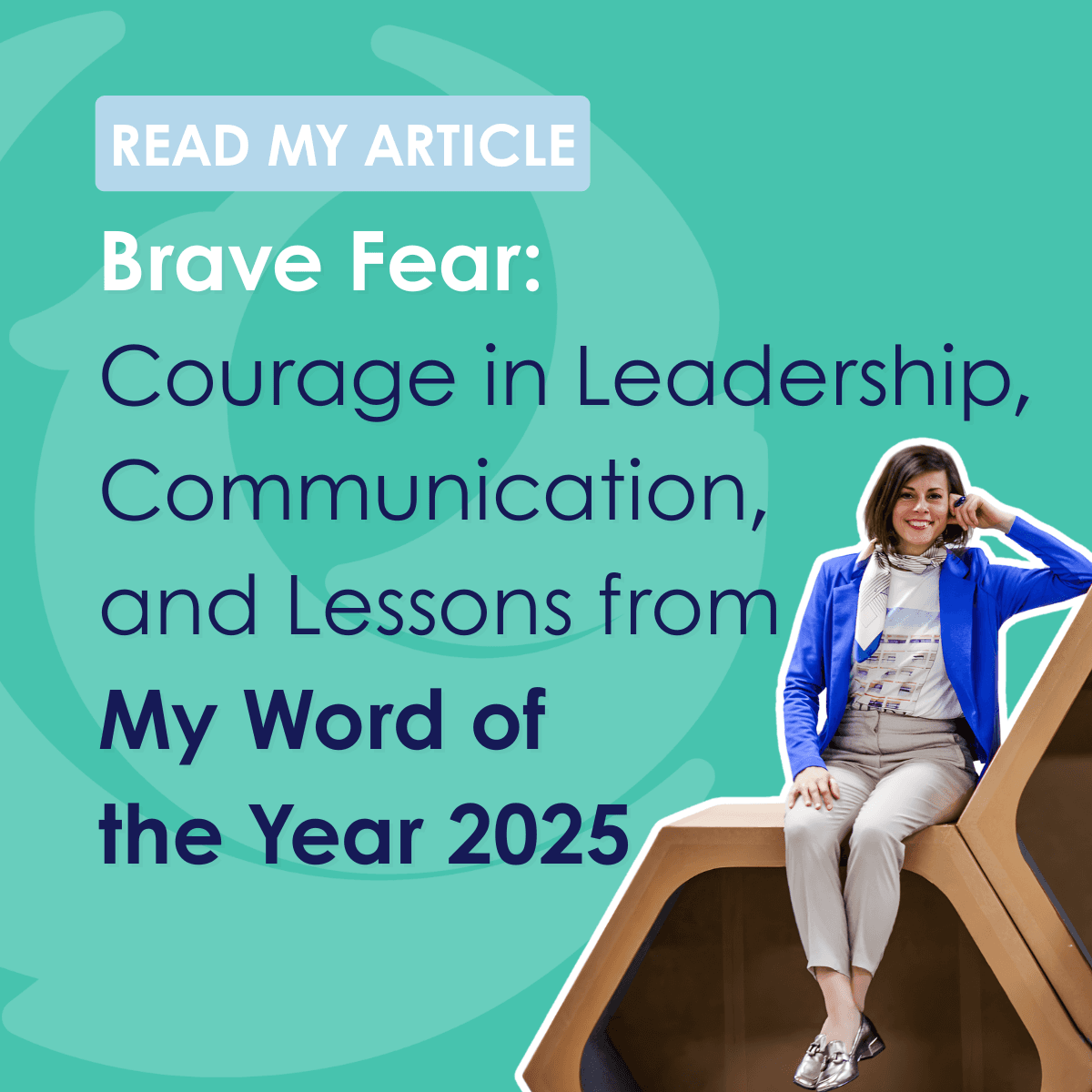
Brave Fear
Courage in Leadership, Communication, and Lessons from My Word of the Year
"You are so brave!” I heard this many times. When I quit my TV job without a plan B and changed my career, when I wrote openly and without taboos about my near-death experience and about losing my voice completely, taking ownership of my weaknesses and vulnerability. Yet I did not feel brave at all. Why?
Every year I choose one word that becomes my internal compass. This year I chose courage. In this article, I explain why and how I see courage appear in leadership and communication as a coach, trainer and mentor.
According to psychological and philosophical research, courage is a quality in which a person consciously chooses to act toward an important goal even when they are aware of fear or risk. This describes exactly how I navigated the challenges of 2025 and what I see in the courageous leaders I work with. Their courage is built from many layers.
The leader who is bravely afraid
Being called brave can feel encouraging and empowering, yet deep inside fear may still be present, and depending on its strength it can be constructive or destructive. So what makes a leader truly brave? For me, a brave leader is someone who consciously manages their fears. However, in my leadership development work I often notice that instead of awareness some leaders try to hide their fears with different masks in order to maintain the appearance of courage. The reasons behind this include the belief that a leader must be perfect and always know everything, the idea that courage equals never being afraid, the belief that trust and empowerment mean losing control, and the assumption that transparency or vulnerability is a sign of weakness and damages one’s image.
These beliefs are often rooted in socialisation, cultural expectations and corporate norms. Their limiting effects can come at a high price, such as loss of authenticity, low loyalty and engagement, lack of trust, overload and burnout.
Transforming fear into courage through conscious communication
How can limitations become opportunities? One powerful method is consistent communication.
1) From perfection to authenticity, the work in progress language
Many of my clients believe that expressing uncertainty means a lack of competence. Yet transparent, concrete and well structured communication provides a sense of safety by expressing openness, clarity and a development oriented mindset. This strengthens trust and psychological safety within the team and it also reinforces the leader’s own confidence.
Practical tip:
Instead of trying to prove you know every detail, use framing sentences such as, “I am still working on this so I can share more concrete details soon,” or, “To make a final decision we still need a few key data points, today we should discuss the following critical aspects.” This type of leadership honesty increases the sense of competence within the team.
2) From control to collaboration, clear boundaries without pressure
Fear often appears in the belief that if I let go of control the system will fall apart. In reality the opposite is often true. A team can only respond reliably to clearly communicated expectations, well defined values and clear boundaries.
Practical tip:
Use shared framing instead of pressure. Team retreats, kick off meetings or onboarding processes are excellent opportunities for this. “Let’s define our goals together and the steps that will help us reach them,” or, “Our boundaries are clear and expectations are high, but let’s explore where we can remain flexible. The goal is to minimise risk and maximise our room to act.” This approach maintains structure while building partnership.
3) From vulnerability to stable presence, turning fear into clear sentences
Vulnerability is not the same as emotional oversharing. Leadership vulnerability means clearly and calmly naming what is real. Saying out loud what everyone knows and feels but no one has yet expressed. This is one of the strongest real time trust building tools.
Practical tip:
Use short, focused sentences with concrete details that create space for reality rather than fear, such as, “This is a highly risky decision, we all feel it. Let’s go through the facts step by step and draw the conclusions,” or, “I don’t yet see how this change will affect our processes, but I am confident we will find the solutions we need.”
My insights
These examples help you stand strong in front of your team and maintain your authority and professional credibility. Yet it does not mean that you will always feel brave on the inside. There were moments in my life when challenges brought me to my knees and taught me to tame my fears. How? By facing the deepest, unspoken and seemingly unacceptable fears through coaching, supervision, therapy and writing. Thanks to these processes I developed a conscious ability to take action even in risky situations, even when I am afraid of the consequences, and to step into situations instead of avoiding them. This is the answer to the question above, I am consciously afraid. For me, courage is fear well transformed.
However, it is not only action that requires awareness. You also need the ability to notice when courage becomes limiting or destructive. My curiosity often helps me transform my fears and keeps me moving forward, yet this year it kept me far outside my comfort zone and consumed a huge amount of energy that I did not fully acknowledge. Driven by action and courage I did not notice the signs that warned me of physical and mental imbalance, and I became exhausted.
Fear should not be underestimated, it is a signalling system that reminds us of our boundaries. If we ignore them, courage alone is not enough and exhaustion can make us unable to act. Fear and courage are partners, and awareness is their teacher. Awareness creates the possibility to stay balanced, maintain motivation, become flexible, resilient and effective, and it becomes the source of loyal, dynamic and well aligned teamwork.
This transformation process carries many possibilities. Transform your fears and act with awareness, not with loud words but with consistent, precise and clear communication so that you can replace masks with authenticity.
Through the summary above, my Word of the Year for 2026 was born within me: HUMILITY. A readiness to preserve human dignity, to honour both myself and others, a willingness for self-reflective presence, mindful awareness, and a generative, pure intention.
(1) The concept of courage in psychology and philosophy is discussed in the work of positive psychology, such as Christopher Peterson and Martin Seligman, and in virtue ethics, such as Aristotle.
juditnagy.info, judit@juditnagy.info